
ABB Makes Biggest Bet
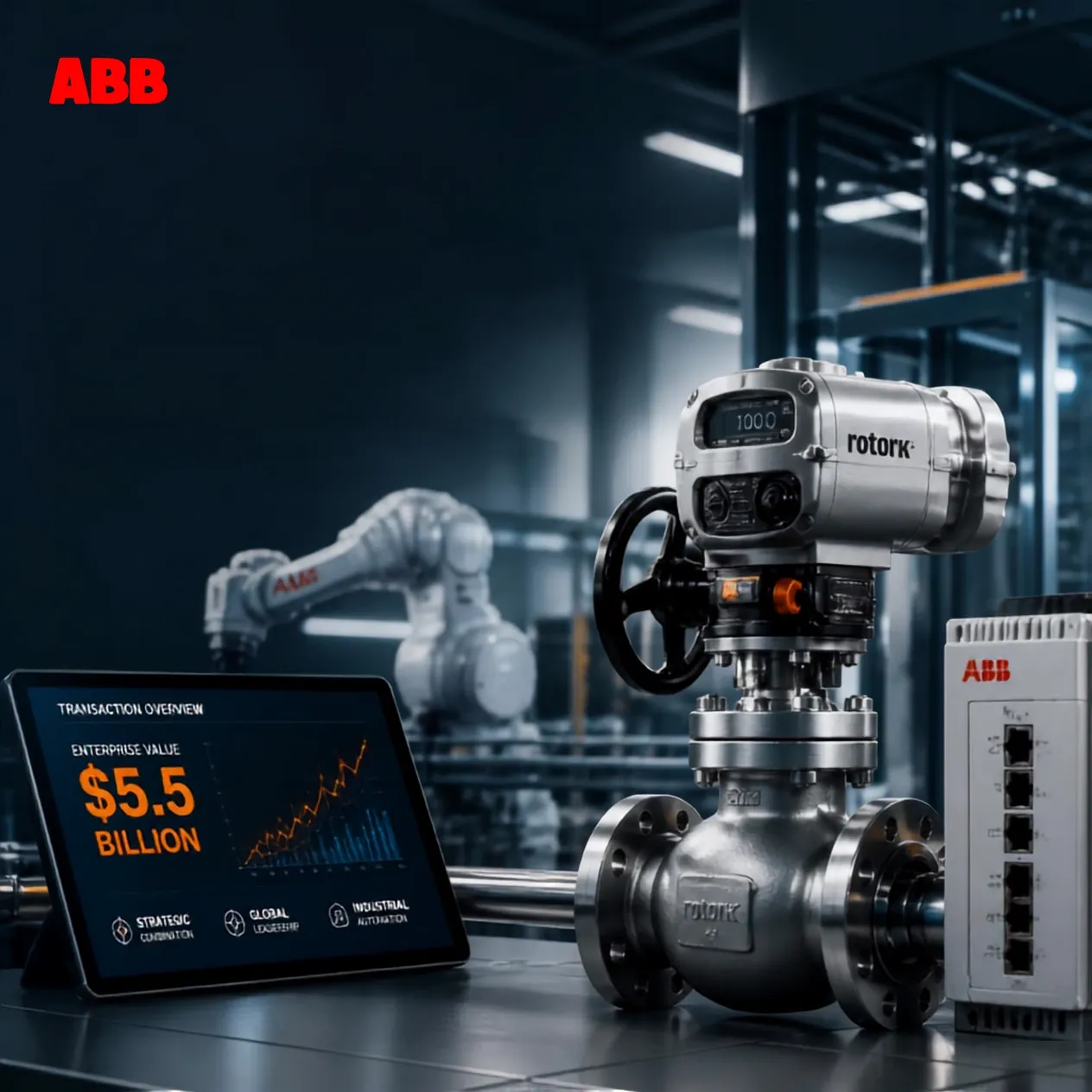
ABB has confirmed a $5.5 billion recommended cash offer for British actuator maker Rotork, marking the Swiss engineering group's largest acquisition ever and comfortably surpassing its earlier record purchases, including the $4.2 billion buyout of Baldor in 2011 and the $3.9 billion acquisition of Thomas & Betts in 2012. Rotork makes equipment that automatically opens, closes and precisely controls valves regulating the flow of liquids and gases, serving customers across oil and gas, water and wastewater, power generation, chemicals, marine, mining and processing industries. With 2025 revenue of around $1 billion a year, Rotork is expected to add roughly 3% to ABB's total revenue, while its 24.6% profit margin should immediately lift ABB's own margins too. CEO Morten Wierod said ABB has followed Rotork closely for years and views the deal as a compelling strategic fit that extends its automation offering right down to the field device level.
Automation Models Shift
The timing is notable. ABB is funding the purchase using proceeds from last October's $4.8 billion sale of its robotics division to SoftBank, showing how earlier divestments are now being redirected into higher-margin, more strategically valuable technology. The deal also fits into a bigger picture unfolding across Britain, where 2026 is already shaping up to be a record year for foreign dealmaking. Rotork joins a growing list of UK-listed companies drawing outside interest, alongside names like Intertek, Schroders and Unilever's food business, suggesting international buyers see real value in established British industrial firms right now.
Platform Competition Intensifies
The Rotork news landed alongside a genuinely strong quarter for ABB itself. Operational EBITA rose 20% to $1.93 billion, ahead of analyst expectations, while revenue climbed 14% to $9.48 billion and net income increased 7% to $1.23 billion. Orders jumped an impressive 30% to $12.04 billion, driven largely by demand tied to data centre buildouts supporting artificial intelligence infrastructure. Investors responded positively, with ABB shares rising roughly 3% in premarket trading in Zurich. Wierod noted that demand remained strong across most of the company's customer segments, reinforcing the sense that this acquisition is being made from a position of strength rather than necessity.
Industrial Leadership Redefined
Put together, the record-breaking Rotork deal and a robust earnings quarter tell a fairly clear story. ABB is entering a more assertive phase of growth, built on reinvesting divestment proceeds into mission-critical technology rather than simply banking the cash. As AI-driven infrastructure spending accelerates and UK dealmaking hits new highs, ABB's move is a reminder that industrial leadership today is less about owning the best single product and more about owning the widest slice of the automation value chain. The race in industrial technology is not only about who builds the smartest automation platforms. It is equally about who controls the components that make those platforms actually run in the field. At InsightSphere, we look at why ABB's record acquisition of Rotork points to a deeper battle over control of the automation value chain.