
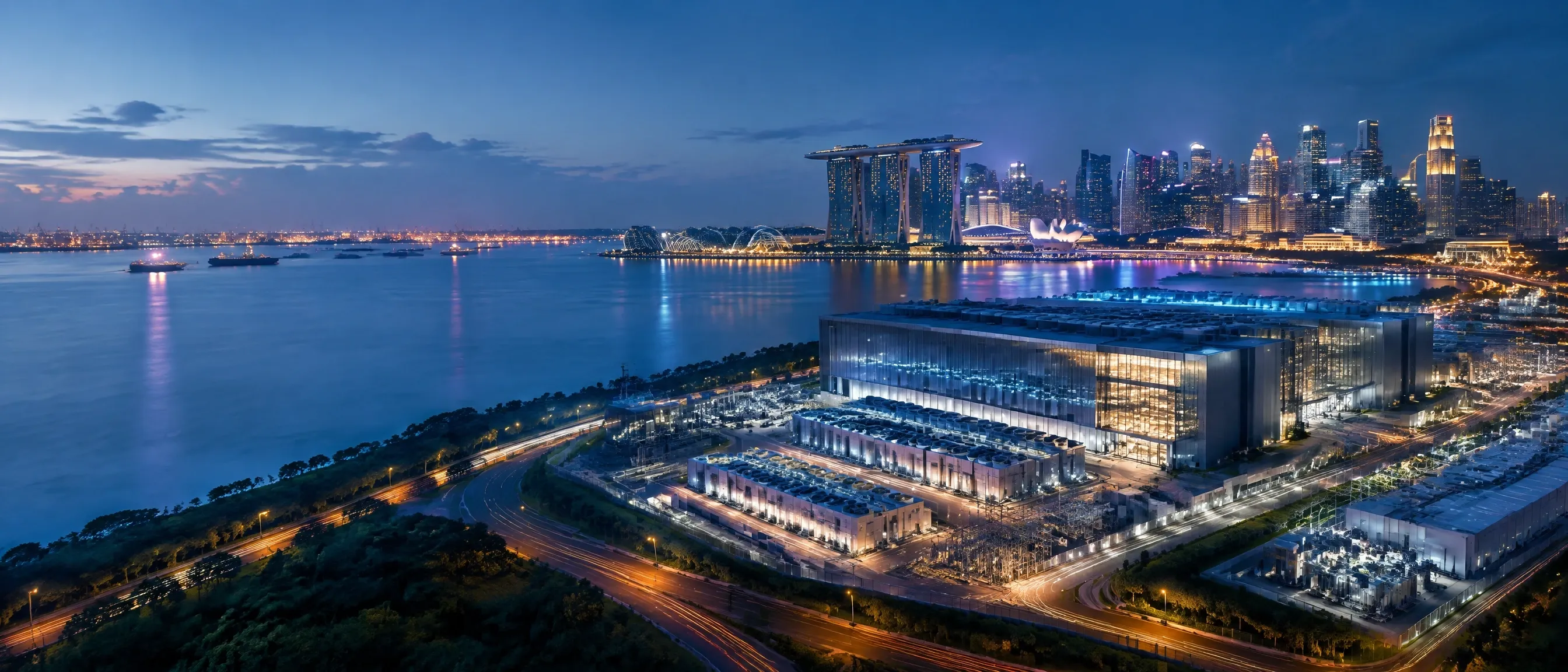
AirTrunk Prepares Landmark REIT Financing
AirTrunk is approaching a major public listing in Singapore as discussions are still ongoing regarding a US$1.6 billion loan in connection with the planned REIT IPO. The financing proposed would be used to raise about US$1.5 billion and could thus make it the largest IPO in Singapore since 2017.
After acquiring it for A$24 billion in 2024, AirTrunk, now owned by Blackstone and the Canada Pension Plan Investment Board, operates hyperscale data centres in Australia, Singapore, Japan, Hong Kong, India, Malaysia, and Saudi Arabia. Instead of listing the operating company, Blackstone is bundling the income-producing infrastructure into a REIT so institutional and public investors can participate in the cash flows from long-term data centre leases.
Data centres are nowadays being valued more in the way of essential infrastructure to support cloud computing and artificial intelligence and less like ordinary office buildings, which reflects a broader trend in the commercial real estate sector.
Starting in early 2025, banks in Asia have approved almost US$29 billion in loans for data centres, yet they have become more cautious as their exposure has increased. As a result, developers are making use of REITs, asset-backed securities, and other methods of financing in order to recycle their capital while at the same time expanding their capacity.
For Blackstone the approach offers financial flexibility since the mature assets can be transferred into a listed vehicle, which brings in a regular income for investors and the money thus obtained can be used to help finance the next generation of AI-ready facilities without having to rely entirely on debt taken over the balance sheet.
Singapore Positions Itself at the Centre of Digital Real Estate
The listing announcement comes as Singapore seeks to establish itself as Asia's leading capital market for digital infrastructure. While the city-state was previously known for logistics, commercial property, and hospitality REITs, hyperscale data centres now represent a different investment opportunity based on cloud adoption rather than consumer or retail demand.
It is important to note that since AI companies have been making aggressive investments in computing power, hyperscale operators have responded by constructing larger facilities all over the Asia-Pacific region. The result has been that data centres have become one of the fastest-growing sectors within institutional real estate, drawing in private equity firms, sovereign wealth funds, and pension investors who are looking for returns from long-term infrastructure.
Capital Markets Expand Beyond Traditional Real Estate
Ultimately AirTrunk's proposed REIT is about the evolving relationship between infrastructure and the capital markets.
It means that for investors AI infrastructure is becoming an asset class that produces income rather than merely being a venture or a technology investment. As for lenders, it indicates that their financing models are changing since the limits on balance sheets are leading to more sophisticated capital structures.
If everything goes according to plan, it could set a new standard for how hyperscale data centre operators earn money from their mature assets in Asia. More significantly, the following wave of AI investment might be just as much financed via real estate and infrastructure markets as it is through technology equity.
InsightSphere continues to track the capital, infrastructure, and market shifts powering the global AI economy.