
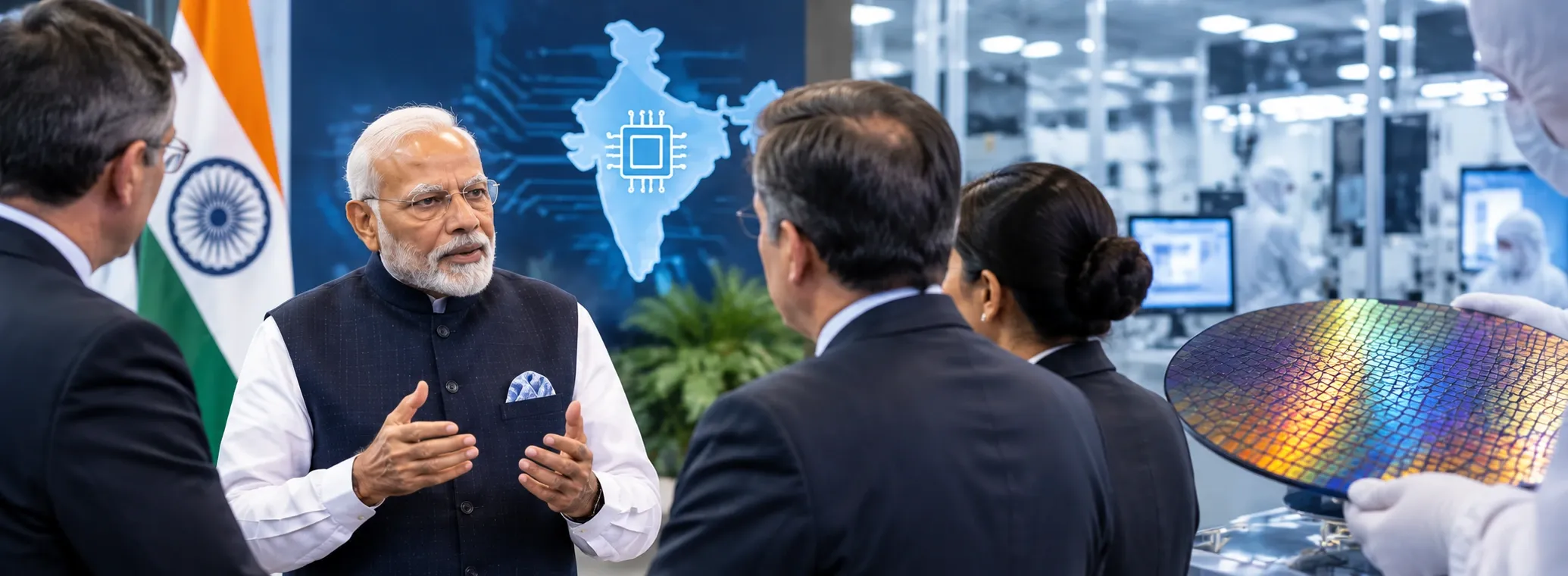
India Puts Its Semiconductor Ambition on Display
More than 600 exhibitors, 150-plus speakers and 300 global companies are expected at SEMICON India 2026, giving the government a platform to attract chipmakers, equipment suppliers, technology partners and customers. The event comes as India broadens its semiconductor strategy beyond attracting individual manufacturing projects. In July 2026, the Union Cabinet approved ₹1.27 trillion for the second phase of the India Semiconductor Mission, alongside a separate ₹62,500 crore mobile phone manufacturing scheme. The combined package is worth nearly ₹1.9 trillion, or about $19.8 billion.
ISM 2.0 is designed to support semiconductor design, equipment, materials, speciality chemicals, research and development, and talent development. The objective is to build more of the supply chain inside India rather than relying primarily on imported components and technology.
From Subsidies to Semiconductor Production
Some of the earlier investments are now moving into commercial operations. Micron Technology opened its semiconductor assembly and test facility in Sanand, Gujarat, in February. Commercial production and shipments of memory modules began at the site, which converts DRAM and NAND wafers produced elsewhere in Micron’s network into finished products. Micron said the facility represents a combined investment of about $2.75 billion with government support.
Tata Group is also developing a semiconductor fabrication plant in Gujarat through its partnership with Taiwan’s Powerchip Semiconductor Manufacturing Corporation. The project has an investment of about $11 billion and is expected to become operational in early 2028. Other Indian groups, including Murugappa, have entered chip packaging and assembly, adding to the early stages of a domestic manufacturing base.
The Race Is About More Than Fabs
India’s challenge is not simply to build semiconductor plants. Chip production requires a network of equipment makers, chemical suppliers, materials companies, packaging facilities, skilled engineers and specialised research capabilities. That makes the government’s expanded incentives important. The second phase of the semiconductor mission specifically targets parts of this ecosystem, including equipment, materials and chip design. Support for research and talent development is also intended to strengthen capabilities beyond manufacturing.
The timing also reflects the wider semiconductor investment cycle created by artificial intelligence. Demand for computing infrastructure has increased the strategic importance of advanced chips, memory and packaging, encouraging governments to attract more production within their borders.
What India Still Has to Prove
India’s semiconductor industry remains at an early stage compared with established manufacturing centres such as Taiwan, South Korea and Malaysia. Much of the initial domestic activity is concentrated in assembly, testing and relatively mature technologies rather than the most advanced chips. The government’s investment commitments therefore need to translate into operating plants, reliable suppliers and commercially competitive production. Micron’s Sanand facility provides an early example of that transition, while Tata’s planned fab will offer a larger test of India’s ability to move deeper into chip fabrication.
SEMICON India 2026 puts those ambitions in front of global investors. The next phase will depend less on the size of the announced subsidies than on how quickly India can turn them into a functioning semiconductor ecosystem.