
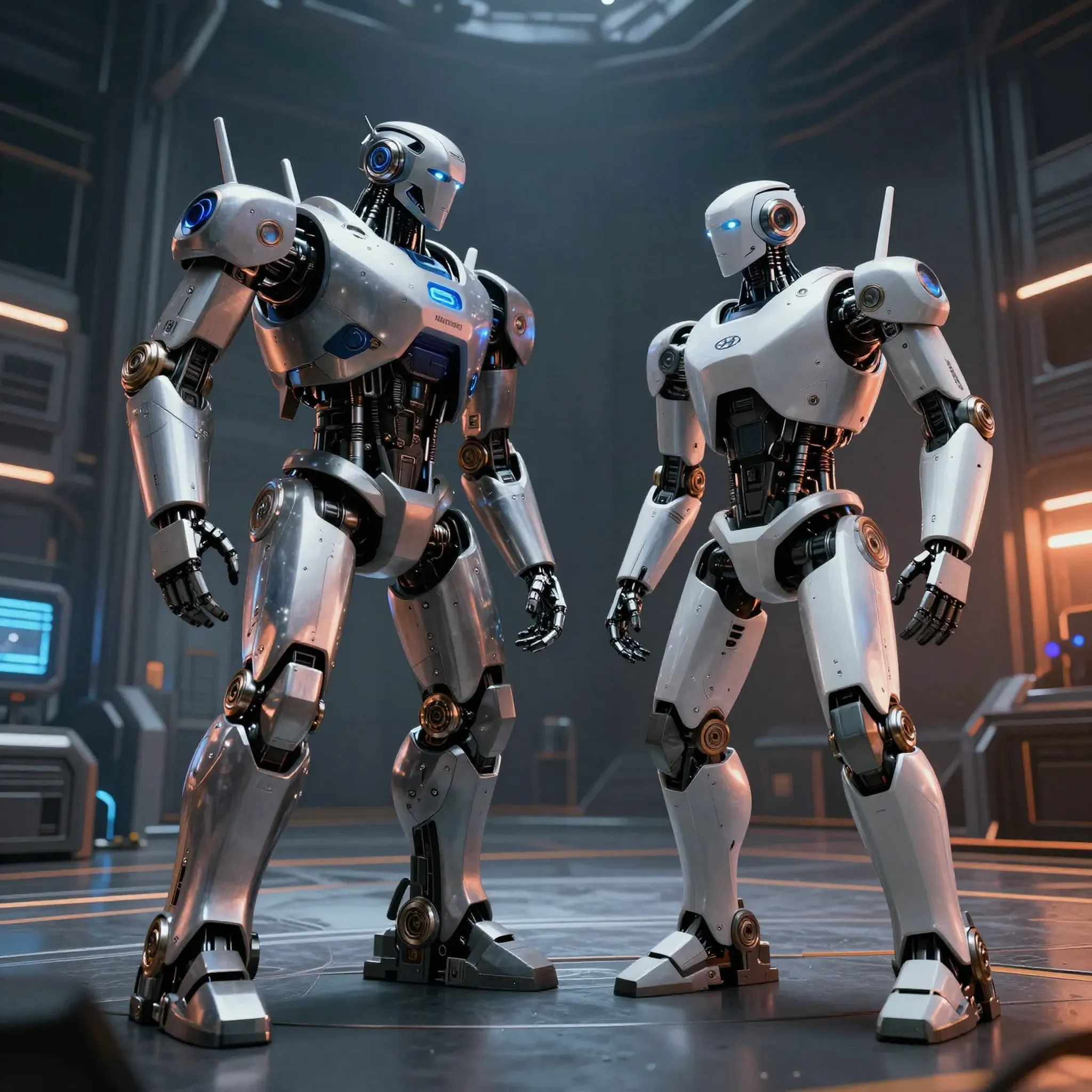
The issue is not about engineering excellence, but analysts viewing humanoid robots as a potential multi-trillion dollar market. In the coming decades, these are capable of reshaping manufacturing, logistics and even household labor. The global humanoid robot market is estimated to reach up to $38 billion by 2035. However, Morgan Stanley suggests that this market would ultimately exceed $1 trillion annually if large scale adoption proceeds. For now, however, the competition between Atlas and Optimus represents the idea of how quickly robots can move from an engineering pioneer to scalable commercial deployment.
Hyundai’s Industrial Robotics
Hyundai’s robotics has gained global recognition following the majority acquisition of Boston Dynamics in 2021 for about $1.1 billion. Boston Dynamics’ Atlas has long been recognised for its advanced innovations, and balance. This has evolved from a hydraulic research to a fully automated humanoid platform designed with commercial applications. Hyundai’s strategy revolves around integrating Atlas into manufacturing and using it for industrial applications. The company aims to use robots handling repetitive tasks or high risk tasks within automotive production lines, areas where labor shortages and safety concerns have increased globally. The industrial robotic installations have reached 5,53,000 units in the world in 2022 (International Federation of Robotics). Hyundai’s, as one of the world’s largest automakers, advantage lies in its vertically integrated systems. The deployment of humanoid robots within its own production units with refined performance before large scale commercialization.
Musk’s Optimus
Tesla’s Optimus have taken a transformative leap beyond electric vehicles. Musk argued that humanoid robots will eventually surpass Tesla’s electric vehicle business model. Optimus leverages Tesla’s existing AI infrastructure, especially their neural network of autonomous driving models. Machines are navigating complex road environments, and apply it to a similar model and decision-making process to humanoid robots. Musk has publicly targeted a price point below $20,000 per unit in the long term, which seems highly optimistic. Achieving this target would require breakthroughs in supply chain optimization and standardization.
Defining Years Ahead
The next decade of technological progress will be to determine if humanoid robots remain niche or become ubiquitous co-workers. Initial deployments are likely to concentrate on controlled industrial settings before expanding into service sectors. Business leaders must caution their delivery timelines beyond early forecasts. As with electric vehicles and autonomous vehicles, commercialization curves often lead to nonlinear results. Still, corporate investment suggests that reliance in humanoid robots will represent a foundation for leading the tech advancements. The Hyundai-Tesla rivalry thus highlights a pivotal moment in the automation industry, where mechanical engineering and artificial intelligence are collaborating together to give scalable outcomes. At InsightSphere, we analyse technological advancements defining global industries and reshaping tomorrow’s economy.