
Biosimilar Race Accelerates
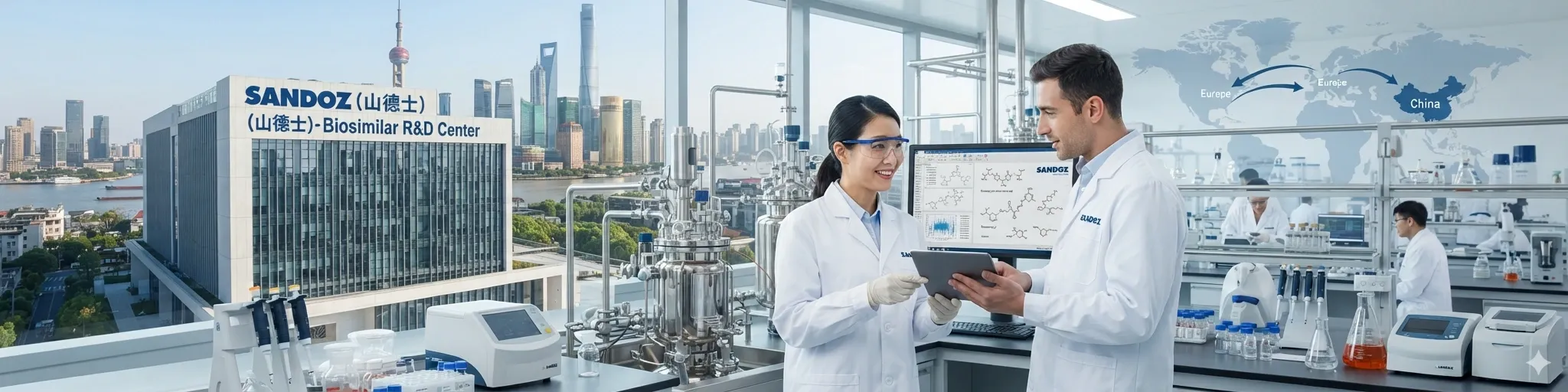
Sandoz has agreed to license three biosimilar drugs from China's Shanghai Henlius Biotech, gaining commercialization rights outside China. The Swiss drugmaker will pay up to $77 million upfront, with additional development milestone payments reaching as high as $160 million and commercial milestone payments adding a further $77 million. The agreement comes at a moment when several major biologic medicines are nearing the end of their patent protection, opening the door to a wave of biosimilar competition. It also reflects how pharmaceutical companies are turning to cross-border licensing as a faster, lower-risk way to build out their future pipelines.
Global Rights Change Equation
The three assets under license target treatments for high cholesterol, lupus, and colorectal cancer, and all remain in clinical or pre-clinical development. The cholesterol biosimilar is based on evolocumab, sold by Amgen under the brand name Repatha, which generated close to $6.6 billion in global sales in 2025. The lupus treatment is a biosimilar of belimumab, marketed by GSK as Benlysta, which generated about $2.5 billion in revenue last year. The third asset targets cetuximab, sold as Erbitux by Bristol Myers Squibb, Eli Lilly and Merck KGaA, with 2025 sales of roughly $1.7 billion.
Together, these three reference drugs accounted for nearly $10.8 billion in global revenue, underscoring the scale of the commercial opportunity Sandoz is pursuing. Since the products are still working through development, their eventual approval timelines and clinical outcomes will play a major role in determining how the deal performs.
China Becomes Pipeline Partner
For Henlius, the agreement offers a route into markets it could not easily reach on its own, tapping into Sandoz's established global commercial network to bring its pipeline to patients outside China. Sandoz gets three promising biosimilar candidates through this deal, saving itself the years of work and expense that would come with developing each one from the ground up.
The arrangement is part of a broader pattern in which Chinese biotech firms are increasingly partnering with established global players to convert strong domestic research capabilities into international commercial reach. As more high-value biologics lose exclusivity in the years ahead, this kind of partnership model is likely to become more common, with companies racing to secure promising biosimilar assets early rather than build them in-house.
Pharma Pipelines Go Global
The Sandoz and Henlius agreement is a clear example of how drug development is becoming more distributed, with companies increasingly relying on licensing deals to access promising pipelines rather than developing everything internally. Sandoz has described the deal as part of its strategy to capture a meaningful share of what it calls an unprecedented global wave of biosimilar opportunity over the coming decade. As exclusivity windows close on some of the industry's most valuable biologics, deals like this one suggest that identifying strong assets early and forming the right global partnerships could become one of the biggest drivers of competitive advantage in pharma.
InsightSphere will continue tracking how these shifts reshape the global healthcare and biosimilar landscape.