
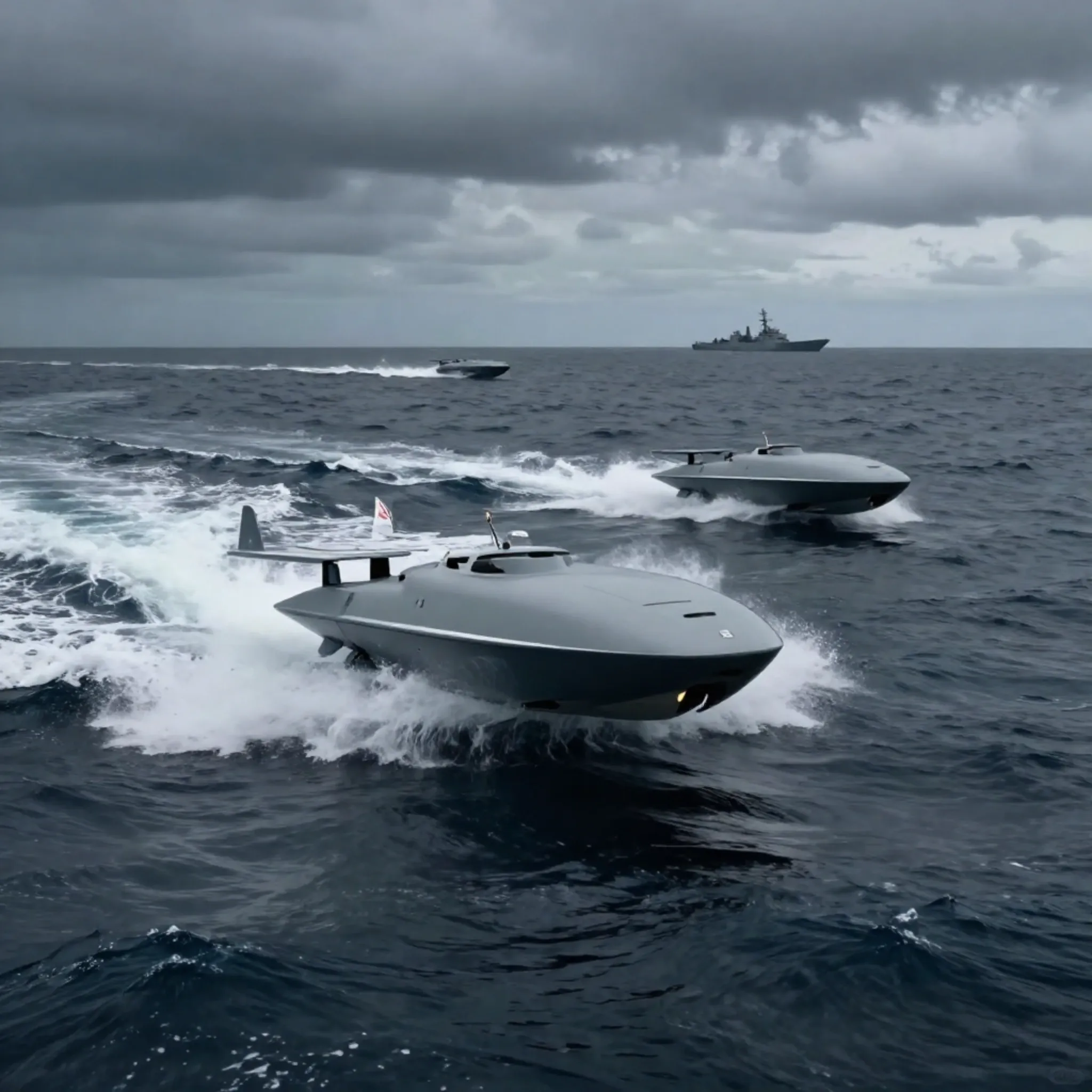
Recent war game exercises have backed this up too, showing that swarms of these small uncrewed boats could genuinely change how a future conflict over Taiwan or the wider region plays out, often forcing a much larger navy to spend time and resources just dealing with the swarm instead of going after the bigger, more valuable ships hiding behind it. What used to feel like a side experiment in naval planning is quickly turning into one of the main pillars of regional deterrence.
Affordable Systems, Strategic Impact
At their core, sea drones are just small unmanned boats, but they can do a surprising amount. Surveillance, jamming enemy signals, laying mines, and even striking ships many times their size. A lot of this thinking traces back to Ukraine, where inexpensive drone boats have managed to repeatedly damage and sink vessels from a navy that was supposed to be far stronger. That lesson has not gone unnoticed in Asia. There was reportedly a recent test run in the Philippines involving Ukrainian-designed strike drones, which is one of the clearest signs yet that battlefield know-how from one war is now shaping preparations for a very different one. Taiwan, for its part, is pushing hard on a homegrown attack drone program as a core piece of its defense plans. Japan is putting real money behind coastal and underwater drone systems, too, partly because it is struggling to recruit enough sailors for its traditional fleet. Neither country is trying to outbuild China. They are trying to make any potential attack expensive enough that it is simply not worth attempting.
Defense Technology Accelerates
All of this is starting to ripple through the business side of defense as well. Money is flowing into autonomous systems, AI, robotics, sensors, semiconductors, and secure communications, basically everything that makes a drone smart enough to be useful. Manufacturers from the US, Japan, and Ukraine are already looking at new production facilities across the Indo-Pacific to keep up with demand. Governments, meanwhile, are pushing for more domestic manufacturing and supply chains that do not buckle under pressure. The bigger shift here is in how procurement budgets are being rethought. Instead of pouring money into a handful of expensive warships, defense planners are increasingly betting on cheaper, software-driven systems that can be built quickly and replaced just as fast. For investors and manufacturers watching this space, it is shaping up to be one of the more durable growth stories in defense right now.
Naval Power Evolves
What is becoming clear is that naval power in the Indo-Pacific is no longer just about who has the most ships. Simulations have already shown that a smaller force using sea drones smartly can hold onto a meaningful chunk of its strength deep into a conflict, buying enough time for allies to step in. As tensions across the region keep simmering, being technologically sharp and quick to adapt is starting to matter just as much as raw size ever did. The future of defense is increasingly driven by software, autonomy, and innovation. InsightSphere helps leaders understand what comes next.