
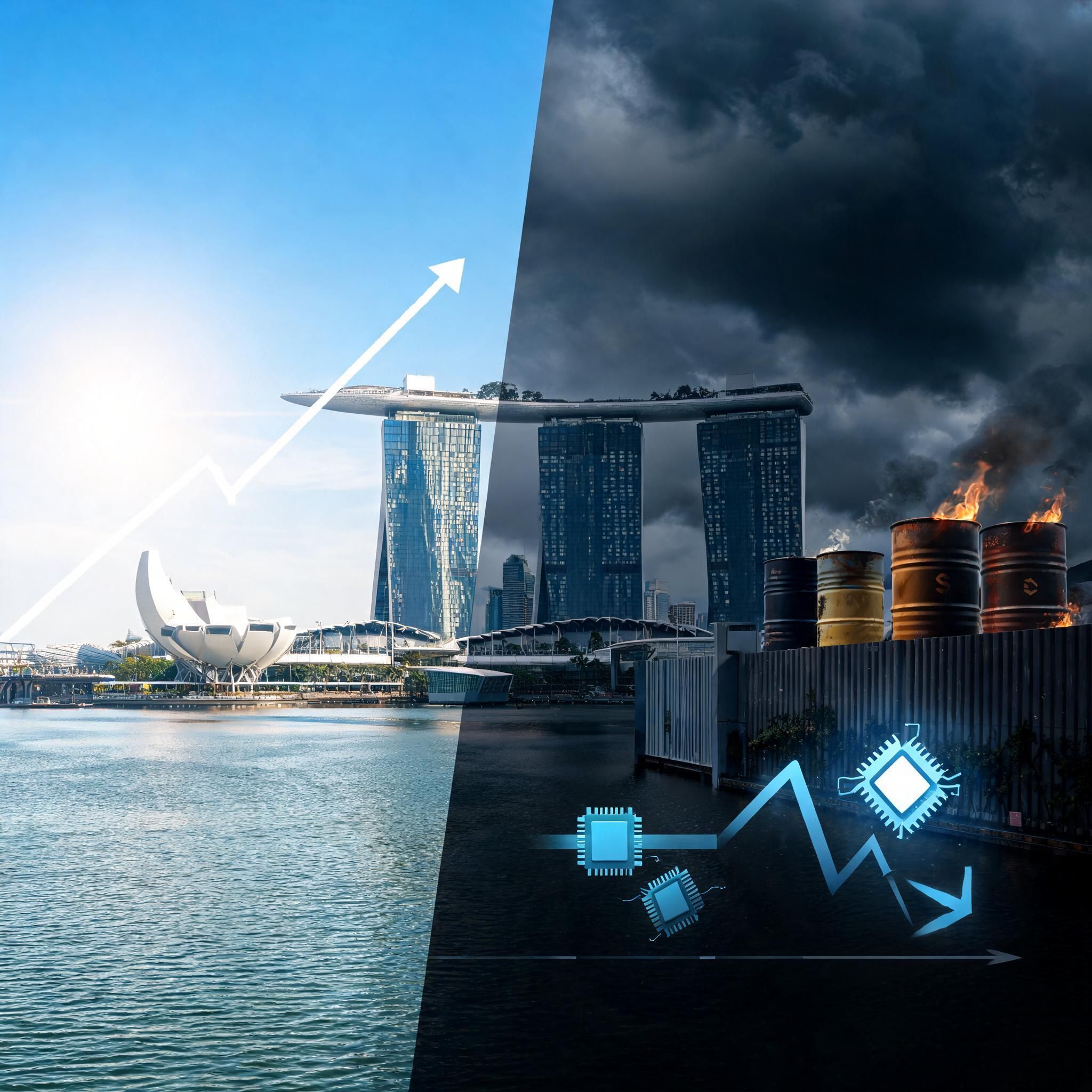
Singapore's Ministry of Trade and Industry followed the data with a direct warning that downside risks to the economic outlook have risen significantly, pointing to energy supply disruptions from the Middle East conflict, potential US tariff escalation, and the risk of a pullback in global AI capital spending. A strong quarter and a dimming outlook landed on the same day, and that tension is the real story.
AI Offsets Pressure
The first quarter beat has a clear driver. Singapore's integration into the AI supply chain through electronics, semiconductors, and digital services delivered measurable results. Overall goods trade rose more than 25% in the first quarter, and the Ministry noted that sustained AI-related capital spending remains a key growth driver for electronics and precision engineering clusters. The energy picture, however, pulls in the opposite direction. The conflict disrupting the Strait of Hormuz is tightening global fuel supply chains, and for an economy that imports virtually all of its energy, rising costs are not abstract. Core inflation held at 1.4% in April, below the 1.8% analyst expectation, offering some relief. But global energy markets remain unpredictable, and that uncertainty is not going away quickly.
Dual Speed Economy Emerges
Beneath the headline growth figure, a clear divide is forming. Technology-driven sectors are expanding with the backing of global capital that shows no sign of slowing. Energy-exposed and trade-dependent businesses are navigating a much harder environment. Singapore's MTI kept its full-year 2026 growth forecast at 2% to 4%, a range deliberately wide enough to account for both outcomes. If the US and Iran reach a deal reopening the Strait of Hormuz, growth could reach the upper end of that range. If not, the downside becomes considerably more real. For business leaders, sector positioning is now a more reliable indicator of performance than aggregate economic momentum.
Technology Buffers Volatility
Singapore's quarter is a useful reference point for executives reading the current environment. The AI investment cycle is producing real output, as the data confirms, but it runs alongside structural vulnerabilities that technology spending alone cannot fix. Singapore's trade ministry noted that energy supply disruptions will likely persist for months even after a geopolitical resolution, as production facilities take time to return to full capacity. The MAS tightened policy last month, the first such move in Asia, signalling that the central bank is managing complexity ahead, not continuity. The growth is there. But it is concentrated, and the leaders who know exactly where they stand within that concentration are the ones best placed to act on it. InsightSphere turns market movements into strategic insight for leaders navigating an increasingly uncertain global economy.